
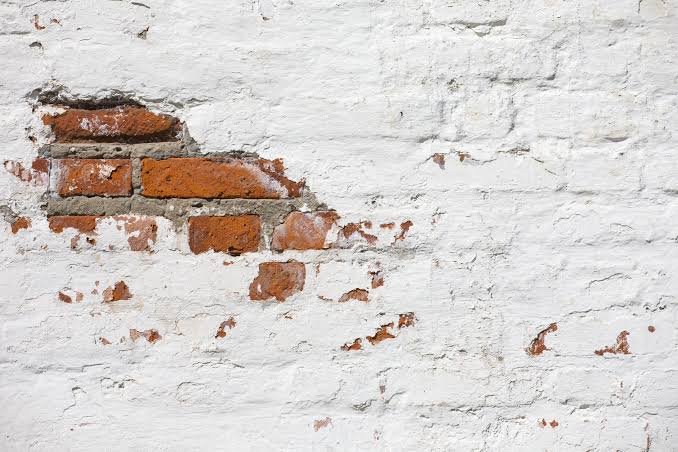
Can you render over painted brick? Usually yes — and it’s one of the most common jobs we’re asked about, because painted brick dates a house faster than almost anything else.
But “usually” is doing real work in that sentence. Render is only ever as sound as what’s underneath it, and paint is a layer between your render and the wall. If that layer lets go, your render comes with it.
Here’s how to know which situation you’re in before anyone quotes you.
The problem in one sentence
Render bonds to the surface it’s applied to. On bare brick, it grips the masonry directly. On painted brick, it grips the paint — and the paint is gripping the brick.
So the question isn’t whether render will stick to paint. It’s whether the paint is still stuck to the wall, and whether it will stay that way for the next twenty years.
The test that decides it
Anyone quoting your job should do some version of this on site. You can do a rough version yourself in five minutes.
The scrape test. Take a paint scraper or a stiff putty knife to a few different spots — a sunny wall, a shaded wall, near the ground, up higher. If the paint lifts in sheets or flakes away easily, it’s failing. If you have to work at it and it comes off in small chips, it’s sound.
The tape test. Score a small cross-hatch into the paint with a blade, press strong tape firmly over it, and pull it off sharply. Paint coming away with the tape is a bad sign.
Look for bubbling and staining. Bubbles mean moisture is trapped behind the paint. Salt staining, chalky white deposits or a powdery surface all suggest the wall is damp, and damp walls need the cause fixed before anything goes over the top.
Check what kind of paint it is. Old, thick, glossy coatings are the worst case. A single coat of breathable masonry paint is the best. If the house is older and has been painted several times over decades, assume the worst until proven otherwise.
What has to happen before render goes on
Where the paint is sound, the wall still needs work:
- Wash it. Pressure washing removes dust, chalking, mould and loose material. Render applied over a dusty surface fails at the interface.
- Remove what’s failing. Any area that lifted during testing gets scraped back, even if it means going to bare brick in patches.
- Key the surface. Painted surfaces are smooth by design, which is the opposite of what render wants. Either the surface gets mechanically keyed, or a bonding agent goes on, or both depending on the paint.
- Prime it. A bonding primer suited to the render system creates the grip the paint can’t provide on its own.
Skip any of these and you get the same outcome: render that looks perfect for a season or two, then drums, then comes away in sheets. When it fails it takes the paint with it, and you’re left with a bigger repair than the one you started with.
When we’d tell you not to
Sometimes the honest answer is don’t.
If the paint is failing widely rather than in patches, stripping it entirely is often more expensive than the render itself, and at that point other options are worth pricing. If the wall is damp and the cause isn’t obvious, that gets solved first. And if the brick underneath is spalling — crumbling, with faces flaking off — rendering over it hides a problem that keeps going.
We’d rather have that conversation at the quote than eighteen months later.
What it’s likely to cost
Rendering over sound painted brick costs a little more than bare brick, because of the extra preparation and the bonding primer. Where paint has to be stripped, cost climbs with the area involved.
That’s why we quote on site rather than over the phone — the preparation is the variable, and you can’t see it from a photo of the finished wall. There’s more on [what rendering costs] in our pricing guide.
The quickest way to find out
Two photos: one close enough to see the paint surface, one stepped back to show the whole wall. Add your suburb and roughly how old the paint is if you know.
We’ll tell you honestly whether it’s a straightforward job, a preparation-heavy one, or one we’d advise against.
Painted brick in Adelaide or greater South Australia? Send us a photo and we’ll take a look.