
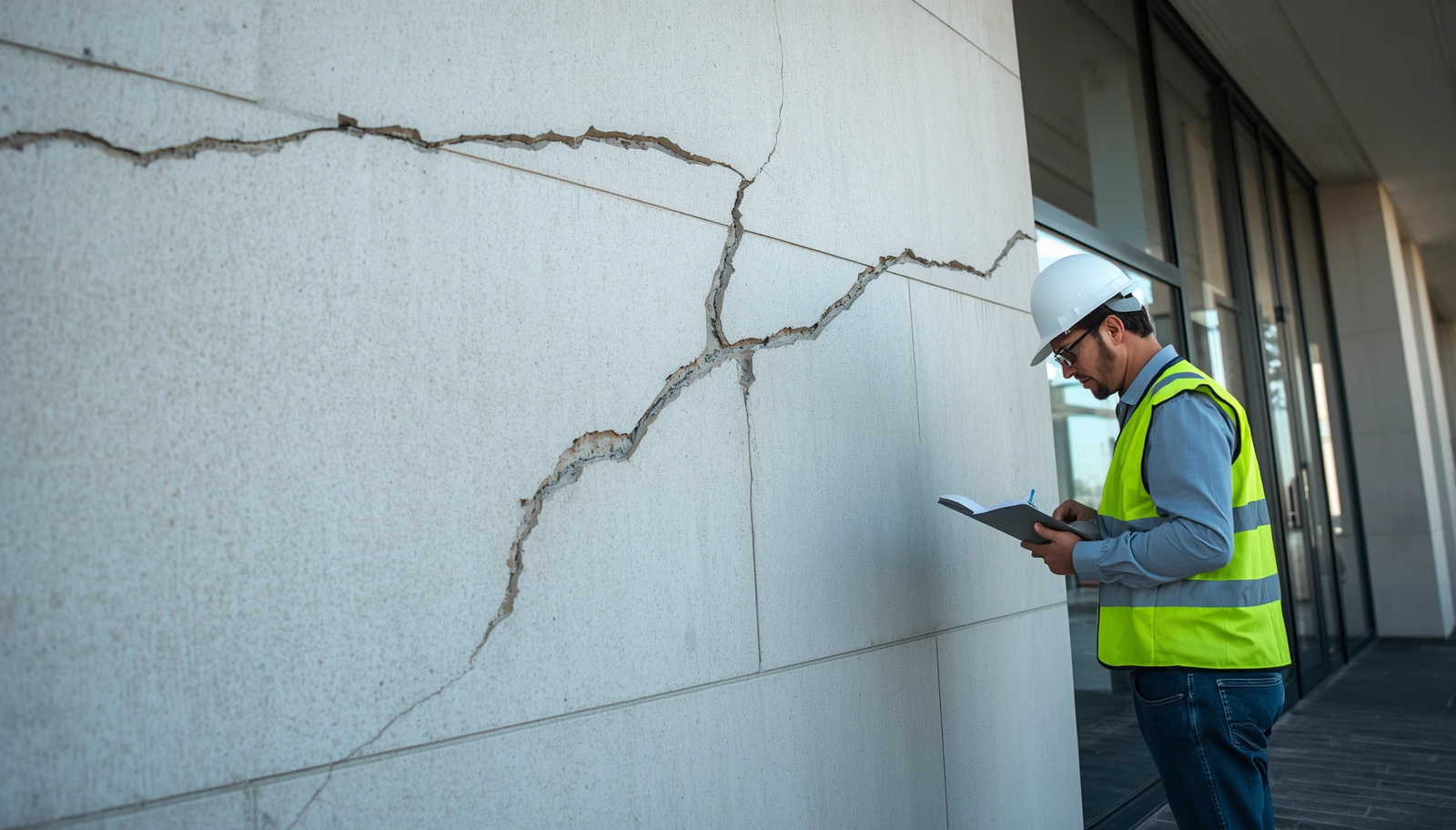
Cracked render is the thing homeowners notice first and worry about most. Sometimes that worry is justified. Usually it isn’t.
The render on your wall is a thin, rigid skin over something that moves. Houses expand in summer heat, contract on cold nights, and settle for years after they’re built. A surface that never cracked at all would be unusual, not ideal. What matters is which kind of crack you’ve got.
The two kinds, and how to tell them apart
Crazing is a fine network of shallow cracks, often described as looking like a spider web or crackle glaze. The individual lines are hairline — narrower than a credit card edge — and they don’t follow the brick or block joints underneath. Crazing is a surface phenomenon. It happens when the render’s outer layer dries faster than the body beneath it, usually because it went on in hot or windy weather.
Crazing is cosmetic. It doesn’t let water in and it doesn’t get worse in any meaningful way. It can be coated over.
Structural cracking looks different. The cracks are wider, they run in a definite direction rather than a network, and they often step diagonally following the mortar joints of the wall behind. You’ll usually find them near the corners of windows and doors, because those are the weak points in any wall. If you can slide a coin into the crack, or if the two sides sit at different depths, that’s structural.
Structural cracking isn’t a render problem. It’s the wall telling you something, and the render is just where you can see it.
What causes render to crack
Thermal movement. Render on a north or west-facing wall in Adelaide takes a beating — surface temperatures swing enormously between afternoon and midnight. Expansion and contraction over years opens fine cracks, especially where the render is thick or was applied over a substrate that moves differently to it.
Settlement. Every house settles. New builds settle most in the first few years, and clay soils — common through much of Adelaide — move seasonally as they wet and dry. That movement transfers straight through to a rigid render skin.
Application in the wrong conditions. Render applied in direct summer sun, or in wind, dries unevenly. The outer layer sets before the body has cured and crazing follows. This one is entirely avoidable and it’s why we won’t render a wall in the wrong weather, even when it costs us a day.
The wrong system on the substrate. Brick, blueboard, Hebel and EPS foam all move differently. A render mix chosen for one and applied to another will crack, sometimes within a season. This is the failure we’re called out to most often.
Missing control joints. Long unbroken runs of render need somewhere to move. Where an expansion joint should have been formed and wasn’t, the wall makes its own — as a crack, usually in the least convenient place.
When it’s worth calling someone
Get it looked at if any of the following are true:
- The crack is wide enough to fit a coin
- It steps diagonally, particularly from a window or door corner
- One side sits proud of the other
- It’s grown noticeably over a few months
- The render sounds hollow when you tap it — this is called drumming, and it means the render has separated from the wall behind
- Water is getting in, or there’s staining below the crack
Fine crazing with none of the above can generally wait until you’re repainting anyway.
One honest caveat: if the cracking is structural, the render is not the fix and no renderer should tell you otherwise. Significant movement cracking needs a structural engineer’s opinion first. We’d rather point you to one than coat over a problem that will come back through our work in eighteen months.
Repair is usually cheaper than starting again
Where the substrate is sound and the cracking is limited, render can be cut out, patched and re-coated for a fraction of the cost of a full re-render. Done properly — with the cause addressed rather than covered — it lasts.
The important part is diagnosis. Patching a crack that’s still moving just gives you a new crack in the same place next summer. That’s why we look at what’s causing it before we quote what to do about it.
The quickest way to get an answer
Take two photos: one close enough to see the crack clearly, one stepped back far enough to show where it sits on the wall. Those two shots tell us more than a paragraph of description, and usually enough to tell you whether it’s worth worrying about.
Send them through and we’ll give you an honest read — including if the answer is that it doesn’t need us.
Cracked render in Adelaide or greater South Australia? Send us a photo and your suburb.